Monday, March 23, 2020

Polarized Training and Athletic Performance


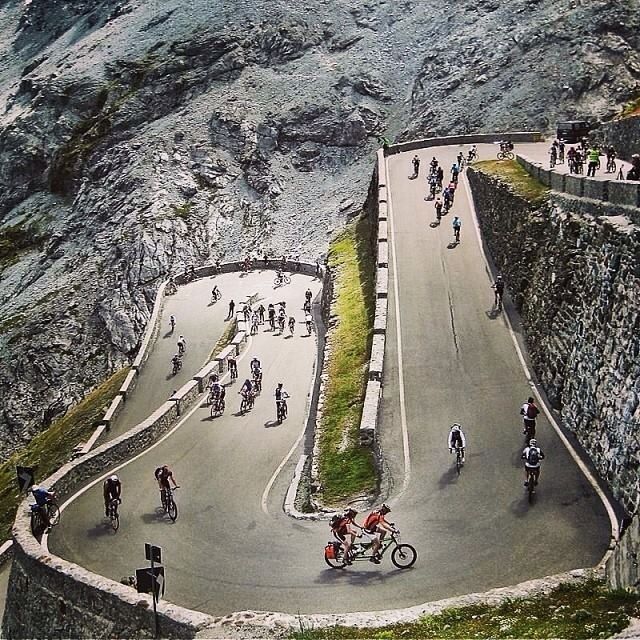
A Hill Climb


Photo from Tavo Mx on Pinterest


[Part 2 of 3 in a series on whether I should give sprint workouts another try.]

Is Polarized Training Better for Improving Athletic Performance?


In my last post I wrote that I had seen no evidence that I would be either more or less healthy if I substituted sprint workouts for some of my moderate intensity cycling. Thus, from a health perspective, I should do sprint workouts or moderate intensity rides entirely determined by what I prefer. Although health is my most important reason for cycling, having fun is also a very important reason and I think I would have more fun if I could ride a bit faster because that would allow me to do more rides with my friends who, as it happens, are faster than I am. Might sprint workouts make me faster?

Polarized training is training done mostly at very low or very high intensity and minimizes riding at moderate intensity. In the context of this series of posts, a polarized training advocate would argue that I should replace some of my riding at moderate intensity with a mixture of sprint workouts and rides even easier than my moderate rides. Vermeire et al., Journal of Strength and Conditioning Research: September 06, 2019 is a paper about the effectiveness of polarized training at improving athletic performance. I am not an expert on exercise physiology so I don't know the names of the reputable journals in the field, but I do recognize the name of the publisher of this journal, Wolters Kluwer, allowing me to tentatively conclude this is a legitimate scientific publication. The journal's claim to be the Official Journal of the National Strength and Conditioning Association suggests it may be much better than that. On the other hand, a big barrier to my reviewing this paper is that to see the full paper I would have had to purchase the article, all I can see without paying is the abstract. Fortunately, there are things we can confidently learn from the abstract. This study looks as 11 recreational cyclists, not a large number. According to the Bicycling article about this paper, these cyclists "were just beginning spring training. All the riders were preparing for a hill climb in the Alps or Pyrenees." At the beginning of the study, athletes were tested for power output at aerobic threshold (a level of effort than can be maintained for many hours), power output at anaerobic threshold (a level of effort than can be maintained for 30 to 60 minutes) and the maximum power that can be generated going all out, an intensity that can be maintained for less than a minute. These athletes then trained on their own for 12 weeks following whatever training plan they liked, but during that training, the amount of time they spent exercising and their level of effort was recorded. At the end of the 12 weeks, the total training load (a combination of time and intensity) was calculated using several versions of the widely used TRIMP method and, in addition, the percent time they spent:
1) below the aerobic threshold,
2) between the aerobic and anaerobic threshold, and
3) above the aerobic threshold
...were determined. The power tests were repeated, and statistics used to determine if there were any correlations between how the cyclists trained and how much their power measures increased.

The first thing I note about this study is that it is both an observational study and a biomarker study*, and thus, as detailed below, has the limitations of both. The second thing I note is that the questions they chose to ask are not the ones I would choose. The first question they ask is if more training load (as determined by one of the TRIMP calculations) is better. Given the assertion that 65% of competitive cyclists train too hard`, I would assume not and don't consider this a particularly interesting question. The second question would, in principle, be more interesting, and that is does the percent of time spent training at different intensity levels matter? This is the polarized training question: is it better to train mostly at high and low intensity (polarized training), or mostly at moderate intensity? Because this is an observational study, that is, they allowed the athletes to train however they liked, their study contains two barriers to answering this question. First, the range of different training programs chosen by the subjects of the study might not cover the range of exercise plans that ought to be considered. What if none of these 11 particular athletes train in a particularly effective way? The second problem, common to observational studies, is that it is impossible to distinguish between cause and effect. Are the best athletes best because of how they train, or do they chose to train the way they do because of their natural athletic ability? It is very possible that athletes who are more gifted find intense training more enjoyable, but that the reason they perform better is not because of this intense training but due to their natural ability. Finally, there is the issue that this is a biomarker study, and more generally, that an exercise plan can only be judged with reference to its goal. The best training plan to win the Tour de France will be very different than the best training plan to win a gold metal in the Olympic 1000 meter individual sprint.

These reservations aside, what were the results of this study? Taking the results the authors reported in the abstract at face value, none of the TRIMP scores correlated with improvement in any of their three power measurements. However, when they fit an equation containing percent of training done at the three intensity levels to improvement in their power measurements, the power at anaerobic threshold was weakly but positively correlated (more is better) with training below aerobic threshold (easy training), was inversely correlated (less is better) with training between aerobic and anaerobic threshold (moderate intensity training) and strongly correlated (more is better) with training above anaerobic threshold (high intensity training, e.g. sprint workouts.) There were no correlations observed with power at aerobic threshold or maximum power. Thus, overall conclusion of this paper is that polarized training is better than moderate intensity training for increasing power at anaerobic threshold. At best, this is a conclusion limited to one parameter, power at anaerobic threshold, and it is left up to the reader to determine the application of that to their real world goals. Unfortunately, the other explanation for their data is that the best athletes who improve most from training prefer polarized training, that it is their ability, not how they train, that is responsible for their better results. Finally, this paper only includes 11 participants and they were free to choose their own training plans so may not have provided the best set of different amounts of high intensity training. That said, I liked the experimental design of looking at the correlation between amount of time spent at different intensities to various measures of fitness. I would be very interested in seeing a similar study done with many more participants and with a more structured set of training plans.

Does power at anaerobic threshold matter to me? Interestingly, after having given this considerable thought, I honestly don't know. I can't ride at anaerobic threshold for much more than 30 minutes and the rides I want to be faster on are metric centuries (62 miles long) and take me more like 300 minutes to complete so it might seem that power at anaerobic threshold would not be all that important. However, these centuries are not a single uniform effort. Rather, their effort varies over the course of the ride. My goal is to improve my ability to stay with my faster friends and maybe if I had more power for short bursts at anaerobic threshold I could stay with them under situations where I am now getting dropped, situations like heading up a hill or when the pace temporarily picks up, but who knows, and that's the problem with biomarker studies. Even if I were persuaded that polarized training would increase my power at anaerobic threshold (the biomarker) there is no way to know for sure if my ability to stay with my friends on a metric century ride will be improved.

I don't want to be negative about this paper, its limitations are due to the difficulties of doing exercise research, difficulties about which I have previously blogged. Sure, its results are far from definitive, but its experimental design is a clever response to the difficulties of these kinds of studies and I think that fairness demands recognizing that it is one more brick in the wall supporting polarized training, albeit a small one. Rather than criticizing this paper I would rather think about what it would take to get past the difficulties that plague this and other studies of exercise, and that is what I will do in the third and final installment in this series. Stay tuned.


* An observational study is one in which participants are not randomly assigned to different protocols (e.g. training plans) but rather chose their own training plan. They are observed, and those who chose one kind of plan are compared to those who chose a different kind of plan. The problem with observational studies is that the two groups are not "matched", those who chose one plan might be different on average than those to chose the other, affecting the results. At first glance this might seem like nit picking, but it is not, especially in exercise studies. People who are naturally more athletic will find it easier and more comfortable to exercise harder and will be overrepresented in the hard exercise groups. How much of their better performance is due to their harder training, and how much their athletic ability? On the other hand, in many cases an observational study is sometimes the only study one can do, an interventional study, where participants are randomly assigned to different protocols is just not possible for any of a variety of reasons. Observational studies ought not be dismissed, but they should be treated with more caution than an interventional study. 

   A biomarker study is one where what is measured is not the thing in which one is interested (e.g. the ability to race up a hill) but something easier to measure that is believed to be related, (e.g. power at anaerobic threshold.) The problem with biomarker studies is that the biomarker might not, in fact, be related to the thing in which one is interested.

` From an article by Coach John Hughes: "My friend and fellow cycling coach Neal Henderson says that 65% of the athletes he sees train too much, 25% train too little and 10% get it right – the pros who are paid to perform."

^ Quote by Thumper, in the Disney film "Bambi".

Saturday, February 22, 2020

Reconsidering Sprints


[Part 1 of 3 in a series on whether I should give sprint workouts another try.]

I started looking at published training plans in about 2012, and from the beginning, I have been skeptical about the value of  sprint workouts (aka brisk training rides aka interval training aka high intensity interval training aka HIIT.) To understand why, consider one example from my recent past. At the end of last season (November 2019) my cycling ability was as good as it has been since I moved to California two and a half years ago. During the 8 to 10 months prior to that I did no sprint workouts. Just before that, about 9 to 10 months ago, my ability was as low as it had been since the move, and it was my impression that my low ability was the result of cumulative fatigue caused by the sprint workouts I had been doing back then. Why, given my many similar experiences, do I still think about giving sprint workouts one more try? Because the exercise community (e.g. the coach-authors*, including the one coach-author I still follow, Coach John Hughes) keep pushing them. But should I be ignoring this advice, as some of my readers have suggest, because it is meant for young racers, not for old fitness and recreation riders like me? Hughes is my favorite coach-author because he focuses on a wider range of cyclists than most, including older and less competitive cyclists like me. Recently, he published two articles (this one and that one) on roadbikerider about the value of interval training for two of his clients, 76 and 62 years old. To be fair, these are stronger. more competitive cyclists than I, but in his book "Anti-Aging: 12 Ways You Can Slow the Aging Process" Hughes also recommends high intensity training for older riders exercising for health. In that book, he claims that a recent scientific paper demonstrated that "intensity training increased the number of mitochondria where energy is produced but neither moderate cardio or strength training increased the number of mitochondria." I have previously noted that I was eager to review the paper from whence Hughes got this assertion and this post is that review. In summary, and with apologies to Coach Hughes, his statement is not supported by the paper he cites and explaining why gives me an opportunity to discuss some important principles useful for understanding a study like this.

Is High Intensity Interval Training Healthier than Moderate Intensity Continuous Training?


The paper I am discussing in this post is Robinson et al., 2017, Cell Metabolism 25, 581–592. The publisher of this paper is Cell Press, one I recognize from my years as a scientist as a highly prestigious publisher, and the study was done at the similarly prestigious Mayo Clinic, so I consider it likely to be a high quality paper. After reviewing it, I have no significant quarrels with the paper itself, but only with how Hughes interprets it. This paper does not attempt to compare the benefits of one exercise program to another, that is, it does not try to answer the question posed in the heading for this section. Rather, this paper is primarily about the changes in gene and protein expression underlying training effects. Because the primary goal of the paper was not to compare the benefits different exercise protocols, the experiments in the paper were not designed to that end. However, this paper does contain data that might speak to the issue, so we can look at it with that in mind, but need to do so with caution.

Two broad categories I use to classify scientific studies are:
  1. Observational versus Interventional studies. Interventional are better, but not always possible.
  2. Biomarker versus Actual Endpoint studies. Actual Endpoint are better, but not always possible.
This paper is interventional rather than observational (that is, it randomly assigns participants to different exercise protocols), so avoids the problems of an observational study, but it is a biomarker study and has the problems associated with that. Specifically, in this case, what we care about (the actual endpoint) is health, but it is almost impossible to measure that directly in an interventional study, so we study something we can measure that we believe is linked to health. The biomarkers used in this study are:
  • VO2peak (a measure very similar to VO2max)
  • Insulin Responsiveness (relevant to adult onset diabetes, for example)
  • Muscle Mitochondrial Activity
  • Fat Free Mass (Muscle Mass)
  • Leg Strength
All five of these biomarkers are generally believed to be good indicators of health so in the interests of brevity I am going to assume that the results of this study are, in fact, relevant to health.

The overall design of this study was to compare four exercise protocols across two groups of participants, a young group (18-30 years old) and an older group (65-80 years old). None of the participants were exercising regularly before the study. This is a common but unfortunate precondition of many exercise studies. I will talk both about why this is common and why it is unfortunate in a later part of this series but will ignore it for this post. This is a fairly small study, each of the eight groups contains only 7 to 11 participants making the statistics of comparison between these groups pretty weak. As a result, only the largest effects can be seen and there is lots of possibility for both false positive and false negative results.

The four exercise protocols were a no exercise control group (SED for sedentary), a High Intensity Interval Training group (HIIT), a Resistance Training group (RT, e.g. weight training), and something they called combined training (CT) which was a mix of resistance and aerobic training. I am going to ignore the details of RT and the resistance part of CT. HIIT involved 5 sessions a week of aerobic exercise. The high intensity part was done 3 times a week and consisted of 4 intervals, each done for 4 minutes at an intensity of > 90% of VO2peak, with 3 minutes recovery between intervals. Converting 90% VO2peak to my training intensity levels, this would correspond to the border between Zone 5b and 5c. For me, this would be a very hard workout. The remaining 2 days a week were 45 minutes at a VO2peak of 70%, roughly equivalent to my MAF tests, an easy workout. The aerobic part of the CT protocol consisted of five days a week of 30 minutes at a VO2peak of 70%, like my MAF test only shorter. Because these protocols involve different intensities, to compare them would require a way to quantitate intensity, and there is no consensus in either the exercise or medical communities as to how to do that. (I have previously blogged about this issue.) That said, based on my intuition and experience I strongly believe that the HIIT protocol involves significantly more aerobic exercise than the CT protocol. Thus, there are three differences between HIIT and CT: the total amount of aerobic exercise, the distribution of that exercise across intensity levels, and the fact that CT includes resistance in addition to aerobic training. If the HIIT protocol were found to be better than the CT and RT protocols, it would not be possible to know if that was due to the greater amount of aerobic exercise in the HIIT protocol, the the higher intensity in the HIIT protocol, or the absence of resistance training in the HIIT protocol. These are very serious and realistic concerns, but having noted them, I will move on.

A lesson offered to virtually all scientists-in-training is "absence of proof is not proof of absence." This is particularly true in a statistical context. Traditionally, the scientific community has used a P value of 0.05 as the cutoff for statistical significance. This corresponds to a 1 in 20 chance that the difference observed is due to chance, or that you are 95% sure the difference is real. If you compare two things and the P value is less than 0.05, then you say the difference is significant. If the P value is greater than 0.05, then you say, not that there is no difference, but that the difference is not significant; that you have not demonstrated a difference. A difference may or may not exist, you simply cannot tell from the experiment you did. Because of the small number of subjects, this is a big issue for this study. Consider the assertion made by Hughes, that HIIT improved mitochondrial activity while CT did not. Here is the data from the paper that speaks to that assertion:


Increase in Muscle Mitochondrial Activity Resulting from Exercise


The dotted line at 0 is placed at the mitochondrial activity at the beginning of the study. If the value is the same as that after 12 weeks of study, then no improvement was observed. Each of the filled in squares or open circles represents the average improvement for the 7-11 participants after the 12 weeks of the protocol shown at the bottom of the graph. The result for each of the participants will be different, and that is how we estimate the variability in the results. Because of that variability, we are not certain that the average of these few participants gives us the exact value of how much each protocol improves mitochondrial activity, and this is shown by the lines above and below the average which give us the range in which we think the answer probably lies (with 95% certainty.) Those groups where the authors are at least 95% sure that mitochondrial activity improved are marked with asterisks. (More asterisks means less chance that the difference is due to chance, that we are more than 95% sure.) First note the SED group, the control group that didn't exercise at all. For both young and older participants, their average mitochondrial activity is lower than before the start of the 12 weeks, but that the difference is not statistically significant, we are not 95% sure that difference is real. In fact, we expect that it is not real, there is no reason for it to change in the absence of exercise. If we only look at the averages, then all three exercise protocols increased mitochondrial activity for both younger and older participants. However, in only three cases can we be 95% sure that is not just due to chance. Maybe RT helps, maybe not. Maybe older participants benefit from CT, maybe not. But now, compare each group not to where they started (the dotted line) but to each other. For example, compare the older HIIT and older CT groups. Although the authors of the study do not compare these two groups, we can estimate the difference by eye, and to my eye, the difference between them is not statistically significant. The difference that is observed is that the comparison between the mitochondrial activity in the HIIT group before and after they participated in the exercise protocol is statistically different, but that the difference in the CT group is not statistically different. I suspect that this is the basis for Hughes' assertion that HIIT improves mitochondrial activity and CT does not. If so, that is an incorrect conclusion from the data. The correct conclusion is that we have significance evidence that the HIIT protocol improves mitochondrial activity, but in the case of the CT group, it might improve mitochondrial activity or it might not, this experiment was not able to answer the question. In short, we cannot say that the HIIT protocol is better at improving mitochondrial activity in older participants than the CT protocol. Based on that, there is no justification for adding a sprint workout to my training.

Let's consider a second example:


Increase in VO2peak (maximum oxygen uptake) Resulting from Exercise

This graph looks at increases in VO2peak with exercise. VO2peak and the very similar VO2max are perhaps the most common biomarker used as a stand-in for the health benefits of exercise. These measure the maximum amount of oxygen a subject can use when exercising as hard as possible. Starting again with SED, the control group, we see the surprising yet statistically significant result that younger participants had their VO2peak decrease over 12 weeks. Despite the fact that this is statistically significant, absent some explanation for this result, I would be inclined to believe that is due to chance. After all, 95% sure is not 100% sure. When we look at the HIIT protocol, we see that younger participants seem to benefit more than older. To me, that says that sprint workouts might have been fine when I was young, but now that I am old, they might not be so helpful. In this case, the difference was so striking the authors calculated the probability that this difference was due to chance, and got a P value of 0.0037, meaning that they were more than 99% sure this didn't happen by chance. For young participants, the difference between HIIT and RT is even more striking; interval training (HIIT) is, with high probability, better than weight training (RT) for improving cardiovascular fitness. In fact, there is no evidence that RT helps cardiovascular fitness at all. (This is the result that would be predicted by both the scientific and exercise communities.) When we compare the benefits of HIIT and CT for younger participants, it looks to my eye to be on the very edge of significance, that we might be 95% sure that HIIT is better at improving CT for young participants. However, when we compare older participants, the average improvement for CT is greater than for HIIT, but but to my eye this difference is not statistically significant. That is, CT and HIIT are, as best we can tell, equally good at improving the cardiovascular fitness of older participants.

Conclusions


My conclusion after reading this paper is that it provides no evidence that sprint workouts improve the health of an older rider like me. Once again, absence of proof is not proof of absence, but if anything, the evidence in this paper suggests that sprint workouts provide no more or less benefit beyond what moderate intensity workouts provide, I should do sprint or moderate intensity workouts as I prefer. Why might I choose to do sprint workouts? First, because they take less time. I hate riding on a trainer, and when doing so, might prefer sprint workouts to get off the trainer as quickly as possible. Second, just because sprint workouts appear to offer me no health benefits doesn't mean that they might not help me become a better recreational cyclists. In my next post, I will ask if sprint workouts might be better than moderate intensity riding at helping me to increase my average speed on a ride, to help me keep up with my faster friends.


* I coined the term coach-author to help highlight the difference between working one on one with a coach and from taking advice from a book or article written by a coach. In the first case, I would refer to the coach as a coach. In the second case, I refer to the coach who is the author of the training book as a "coach-author". The reason this is important is if I were working with a good coach one on one, they would see how I responded to different training plans and would adjust their recommendations accordingly. In contrast, once a coach puts a training plan into a book or article, it becomes one size fits all, it might work for me or it might not.


Saturday, January 4, 2020

Metric Century Progress Report

The Joy of a Group Ride
(The Great Western Bike Rally, 1968)

My first group ride after moving to California was the 2018 Art of Survival which I rode with my high school riding buddy, Roger. Back in 2016, at the Modesto Roadmen 50th Reunion, Roger urged me to ride Eroica California with him. I couldn't join him in 2017 because I was caring for my sick wife. When, in 2018, I again couldn't go with him, this time because I had pneumonia, Roger suggested the Art of Survival as another ride we could do together, and I managed to make that one. That event offered rides of various lengths, and Roger and I decided to ride the "metric century", a ride 100 kilometers (62 miles) long. The Art of Survival is held near to where Roger lives, a seven hour drive from where I live, so I spent both the night before and the night after this ride with Roger and his wife Janet and we had lots of time to talk about many things, one of which was Roger's plan to ride a metric century a month. I was very excited by Roger's plan, and decided that I, too, should try to do that, a plan I announced on this blog the following August.

Precisely what were Roger and I planning? Subsequent history indicates that Roger had a well thought out plan but I confess that my adoption of Roger's plan was an impulsive response to his enthusiasm and thus not carefully thought out. I think the reason I got excited is that I had really enjoyed the ride we had just done and wanted to keep doing rides like that. Upon reflection, there were two attractions of the Art of Survival ride that made me I want to do something similar on a regular basis: the social aspect and the challenge; I had found the ride hard but doable. Unlike the 200 kilometer rides I was doing five years ago, I hoped that I could do 100 kilometer rides without the months of preparation the 200 kilometer rides required, that they would not leave me so tired that it would be a year before I could do another one, and that I could do them on the hilly roads of California. And I also wanted to ride with Roger and with large groups of other cyclists.

When I got home, I started looking for more group metric centuries and built up a list of almost 100. The sources I used to assemble this list were the California Bike Ride Calendar and California Bike Rides. I took me some time to assemble this list, my babysitting responsibilities increased with the birth of my second grandchild, and as I worked my way through the list, I found that, for a variety of reasons (too expensive, too hard, ...) not all of them were rides I wanted to do. In fact, the first one I decided to try was The Golden Hills metric century in October. I mentioned it to Roger, he was interested, so we rode it together and had a great time. I also found that these group rides are not evenly distributed throughout the year. There were 17 rides in October, 1 in November, 0 in December, 0 in January, 1 in February,  and 2 in March, so all of a sudden, I was staring at April and Eroica California. The good news was that this year I finally made it to Eroica. The bad news is that the ride I chose was not a metric century. Why? Because the shortest ride at Eroica which qualified as a metric century was just too hard for me.

What made this ride "too hard?" As a general point, it is extremely difficult to come up with a route for a ride which is exactly 100 kilometers (62 miles) long, so a typical metric century is at least 100 kilometers long. Thus, at a given event, the shortest ride over 100 kilometers can be significantly longer than that. The shortest ride at Eroica was 33 miles long. The next shortest ride was 74 miles, more than the 62 miles of a metric century. But the problem with this ride was not so much the 12 extra miles as it was the hills. My 33 mile long ride included 1,400 feet of climbing. The metric centuries I have ridden have had about 2,000 feet of climbing. The 74 mile ride had 5,700 feet of climbing.

How much climbing is too much? During the 2019 season, I learned that I can ride 65 miles, I can climb 4,500 feet, but I probably can't do both on the same ride. The two metric centuries I rode were rated as "easy", but I still found them to be about as much as I wanted to do. They were each about 65 miles long and each had about 2,000 feet of climbing. In July of 2019, I rode a one pass version of The Death Ride which was 49 miles long with 4,500 feet of climbing, and I felt like that is was absolutely the hardest ride I can complete. One rule of thumb I have come across is that in terms of difficulty, is that 100 feet of climbing is equivalent to 1 mile of distance. If we add feet of climbing divided by 100 to distance to get a difficulty score, then the two metric centuries I rode each had scores of 85 and The Death Ride had a score of 94. Based on how hard I found the rides, that feels about right to me. The ride I did at Eroica had a difficulty score of 42, easier than I might have ideally chosen, but the next longer ride had a score of 130, more than I think I should attempt.

Another factor that affects ride difficulty is how fast the ride is ridden, not in absolute terms like miles per hour which is affected by things like how much climbing there is in the ride, but in relative terms, how hard I push during the ride. Consider my Go-To Alpine ride, 23 miles long with 1,300 feet of climbing which I have ridden approximately 100 times over the last two years. The fastest I have ever completed it is in 1 hour 44 minutes, the slowest, 2 hours 9 minutes. The fastest ride left me a lot more tired than the slowest. Despite my out of control compulsion for analysis and metrics, this is not an attempt to add one more parameter to my difficulty score but to recognize that such a score has its limits. This is just one example, there are many more factors that affect ride difficulty (e.g. choice of bike) but length and amount of climbing is where I stop.

At the top of this post, I noted that one of my major reasons for wanting to ride a metric century a month was because they provide opportunities to ride with my friend Roger. But even on my first ride with him, the 2018 Art of Survival, I realized he is a much stronger rider than I am. In contrast, he and his brother-in-law Dave, who ride together a lot, are similar in ability. For Eroica 2019, Roger and Dave did the 74 mile ride, while I did the 33 mile ride. For Golden Hills 2019, they did a full century (101 miles) while I did the metric (65 miles). Roger and Dave completed metric centuries each month from April through October of 2019, and they invited me along on all of them. In the end, I did Eroica, Art of Survival, and Golden Hills with them (albeit over easier routes in some cases.) Many of their other rides were too much for me, having up to 7,000 feet of climbing. As we were leaving Golden Hills this year to make our separate ways home, we shouted out "See you at Eroica!" I hope so, and I hope we see each other at Art of Survival and Golden Hills as well. That said, the reality is that they will want to do rides that are beyond my strength. As much as I would like to join their team, I don't qualify. What, then, should I do going forward? I don't need to ride metric centuries for my health, I can satisfy that need with much less riding, so I should do what is fun, and I think the social aspect more than the challenge might be the key to that. Right now, I am looking at the ride schedule of one of the local bike clubs, the Western Wheelers. Maybe riding with them is just what I am looking for.

Training


Wait, what, all of those posts on training for a metric century, that was all for nothing? Not at all! Even if I add no metric centuries to my schedule in 2020 beyond what I rode in 2019, I still need to get in shape for The Art of Survival in May and The Golden Hills in October. I have come up with two different approaches to being in shape for a metric century. The first is used when I have not ridden a metric century the previous month. It is the plan I used to prepare for the 2019 Golden Hills metric century. If I am routinely riding a 34 mile ride each week (which I am currently doing) it takes me 4 weeks to get ready for a metric century. The second training plan is to be used when I want to ride metric centuries two or more months in a row. Again, assuming I stick with my schedule of riding a 34 mile ride each week, then that is all the preparation I need. The only problem was that I had never tested that second plan, I had never ridden a metric century two or more months in a row. When I got home from Golden Hills in October, I executed my "metric century a month" training plans over the next 4 weeks and in November, I rode a solo 100 kilometer ride on local roads, and it went fine. I was tired at the end, but not overly so. A solo ride lacks the social aspect of the Metric Century a Month plan and is not a substitute for that, this was just a test, but a test I passed. Thus, the training plans I have blogged so much about should allow me to ride Group Metric Centuries whenever I want.


Monday, December 2, 2019

Bay Trail

Cover of the box containing the maps of the San Francisco Bay Trail
The San Francisco Bay Trail is a work in progress which has as its goal a Hike and Bike trail running completely around the San Francisco Bay. When completed, it is expected to be about 500 miles long. To date, 350 miles have been built and are available to ride. Who is building it? the Association of Bay Area Governments, known as ABAG, is organizing the effort. ABAG describes itself as "part regional planning agency and part local government service provider." ABAG was established in 1961 and in 1989, California State Senate bill 100 authorized them to begin development of the San Francisco Bay Trail. Although ABAG does the planning, the actual building of the trail is being done by the 47 governments along the route of this trail, all of which have agreed to be part of this project. These communities use the same process and funding sources to build the section of the trail going through their community as they would use for any other pedestrian or bicycle infrastructure.

When I heard about the San Francisco Bay Trail, I googled it and found its website. The first thing I looked for there was maps of the trails. There are maps online, but there are also paper maps for purchase, and I purchased a set of maps from the online store at the Oakland Museum of California. One concern with paper maps is they can quickly go out of date. This set of maps was copyrighted in 2016, so would appear to be at least 3 years old. So far, I have not encountered any discrepancy between the map and what I find out on the road, but I am sure I will as time goes by.

The map comes in the form of a deck of 24 4x7 inch cards, each card showing one section of the trail in high resolution. The cards are laid out around the bay as shown below:


So far, I have ridden two sections of this trail, one shown on Card 4, and one shown on Card 6. This is the section of the trail shown on Card 4:


Note that the start of the trail is purple, indicating a trail not part of the SF Bay Trail, in this case a very high quality bike and hike overpass over Highway 101. 101 is always difficult to cross so this overpass is much appreciated. The overpass leads directly onto the Bay Trail. The start of the ride is only 3 miles from my house, so the 20 miles of SF Bay Trail were the focus of the ride. This section of the trail is all paved and travels through heavily populated suburban parts of the Peninsula. I first rode it on July 4, and as expected, the trail was quite busy with bikers ranging from riders in full spandex on carbon road bikes to families with kids. Mixed with the bikers were joggers and walkers. It is definitely not the best place for an all-out training ride, but for a fun ramble, it works well. It is also not the best place to get away from civilization. The trail is 100% car free, but often runs next to roads so cars and houses and the other trappings of civilization are never out of sight. The trail runs through a number of popular parks which contributes to both the crowding and the charm. July 4 was windy this year, and I especially enjoyed the families flying kites. A final point important for setting expectations is that much of San Francisco Bay is more like a wetlands rather than a deep water port; frequently, the "bay" one is riding next to is mud rather than water, especially at low tide.

The section of the Bay Trail I rode that is covered on Card 6 is about 4 miles long and is 15 miles away from my home, so it is part of a longer ride rather than its focus:


Note that, once again, I started on a trail not part of the Bay Trail, the Stephens Creek Trail, a truly wonderful ride that I have mentioned here before. Despite being located near a very heavily populated part of the Peninsula, the trail itself is a bit separated from civilization, so riding has just a bit of a "getting back to nature" feel, though bridges and powerlines were never out of sight. The biggest difference between this and the section of trail I discussed above is that majority of this stretch of the trail is dirt/gravel rather than paved. Were it not for the map cards encouraging me, I might have wondered if me and my bicycle truly belonged, it looked more like a hiking than a biking path, but encouraged by my card, ride it I did. I rode this stretch of the SF Bay Trail on my Public Bike, an urban commuter, not a mountain or gravel bike, but it did just fine. The trails are quite smooth and reasonably firm. The biggest difference between the gravel and paved sections is that the gravel sections can have large mudpuddles, especially after a rain, so bikes do get dirty and fenders are much appreciated. How well these unpaved sections worked was a revelation for me. From now on, I will have no reluctance about riding the parts of the trail marked dirt/gravel.

I rode Card 4 and Card 6, what about Card 5? Much of the trail on Card 5 is drawn in dotted lines, indicating that it hasn't been constructed yet. There are alternative routes through much of this area, I have ridden on some of them, and it can be done, but it is not the seamless car-free experience that I describe above.

What's next? There is quite a bit of trail I have yet to ride connected to what I have already ridden, and I look forward to riding that, but ultimately, I am going to run into the dreaded dotted lines, gaps in the trail that remain to be filled. The metric that truly matters, in my opinion, is less the 350 of the 500 miles of trail have been built, but more how long the contiguous stretches of trail run, for that determines how long most people will ride before turning around and going home. That said, there are some stretches near where I live that make for a nice, car-free day ride. My older son his wife and I used to enjoy biking together, and now that they have kids, I would really enjoy taking them along. However, my daughter-in-law is not comfortable taking her kids into traffic on a bike. The San Francisco Bay Trail provides the perfect solution! All we need to do is to purchase and install bike seats, and a lovely car free day outdoors is ours.

Friday, November 1, 2019

Sad Surly Story

The Zombie, riding his cronenberged 1967 Hetchins Mountain King in the 2019 Gold Hills Metric Century

"It's springtime for Hetchins and vintage bikes, it's winter for Surly, so sad!" - To the tune of "Springtime for Hitler", apologies to "The Producers"

One thing I did not mention in my post about the 2019 Golden Hills Metric Century is that I rode it on my newly resurrected Hetchins. It wasn't supposed to be that way. Way back in 2018, in preparation for my first California metric century,  The Art of Survival, I decided I had neglected routine maintenance on my poor Surly Crosscheck for so long that I needed to do that ride on my Bianchi Volpe. Until then, the Surly had been my go-to bike,  the bike I rode unless there was some reason not to. After that, my Volpe became my go-to bike. Once I took care of the deferred maintenance on the Surly, my Volpe needed maintenance, so I swapped the Volpe for the Surly. This was a few weeks before the 2019 Golden Hills metric century and so the logical thing to have done was to ride Golden Hills on my newly overhauled Surly. But when I rode the Surly, I did not like the way it felt. So a plan was born, I would ride Golden Hills on the Hetchins, even though its gears were not as low as I would like, even though it had attachments for only one water bottle, even though I did not have a rack to carry the warm clothes I would need at the start of the ride.

How did the Hetchins do? It did great! As I have posted before, the lack of low gears on some of my bikes has turned out to be less of an issue than I initially feared, and once again, gears were not an issue on this ride. Some of the other potential issues which I mentioned earlier never materialized; the shift levers never slipped and the "soft" wheels held up fine. As for the lack of water bottle cage and rack, I figured out how to stash both warm clothes and a second water bottle in my jersey pockets. I have come to love the way the Hetchins rides and I continued to enjoy that during Golden Hills. Also, the Hetchins is a remarkable, vintage bike and I got to show it off. All and all, the decision to ride my Hetchins, initially forced on me by circumstance, turned out to be a huge win.

But what was wrong with the Surly? It had been my go-to bike nine years! Well, therein lies a story. It turned out that a lot of what I didn't like about my overhauled Surly was the saddle. I have come to prefer a well broken in Brooks B17 saddle so much so that I almost can't ride anything else. Unfortunately, I only have one of those and at the time my Surly came home from the bike shop, the it was in use on the Hetchins. I had a newer B17, less well broken in, that I put on the Surly, figuring it was close to being broken in and that it was about time to finish the job. So one problem was that the saddle was too hard. I made allowances for the hard saddle, but my intuition told me there was more wrong than that, and it turned out I was right. Another problem was not the saddle itself, but adjustment of the saddle. In my blog post "Saddles and Bike Fit" one adjustment I did not talk about was the tilt of the saddle, the extent the saddle is level, has the nose pointed up, or has the nose pointed down. I always thought that saddles should be level and I don't recall tilting of the saddle ever being an issue before. It was not that the saddle felt wrong on the Surly, it was that I felt like I had way to much weight on my handlebars. That was surprising, because weight on the handlebars is normally caused by low handlebars (relative to the saddle height), and my Surly has the highest handlebars of any of my bikes. When I thought about what else might cause that feeling, it occurred to me that if the nose of the saddle were too low, I might tend to slide forward, putting weight on the handlebars. When I looked back at the Hetchins, I noticed that the saddle was not quite level, the nose pointed up just a bit. Once I adjusted the tilt of the saddle on the Surly with the nose slightly up to match the Hetchins, the Surly became much more comfortable. (A number of cyclists on the Internet note that being more comfortable with the nose a bit up is yet another peculiarity of B17 saddles.) Had I figured this out sooner and/or if I had moved the broken-in B17 from the Hetchins to the Surly, I might have decided to take the Surly to Golden Hills, a decision that, in retrospect, would have been a lost opportunity to enjoy my Hetchins.

My Surly is much more comfortable now than when I brought it home from the shop, but I still prefer my Hetchins - by a lot! Why is that? Again, part of it might be the difference in saddles. The B17 on the Hetchins is well broken in, the one on the Surly still has a ways to go. If so, that should be a self correcting problem, and to that end, I am going out of my way to put miles on the Surly and its still-hard saddle as well as slathering that saddle with Brooks Proofide. However, I think there is more to it than the saddle. Back when I was in High School, the Modesto Roadmen had a belief that different bikes had different feels when ridden, some better, some worse, and that there was no way we could tell by looking at a bike how it would feel. I remember that we found that Raleigh bikes usually rode better than we expected, for example. As a scientist, I have to believe there is no magic to this, and as I have come to learn more about bicycles, I have learned some things that are less apparent but impact ride quality. One set of things, visible but perhaps not obvious, is frame geometry. Another which is entirely invisible to the naked eye but apparently has a big impact on ride quality is the kind of steel tubing used to make the frame; that tubing can be made from different grades of steel and the walls of that tubing can have different thicknesses. I think some of that is going on between the Hetchins and the Surly. Gebhardt at Veloro Cycles has suggested that wheels and tires might be a factor as well. The Hetchins feels quite lively, whereas by comparison, the Surly feels like a brick. This is not new. Although the Surly was my go-to bike for nine years, this was despite it having a bit of an unresponsive feel. Part of the reason this did not bother me more at the time was that the only bike I had to which I could compare it was my Bianchi Specialissima, and the fit of the Surly was so much better as to more than compensate for any difference in frame feel.

Seat firmness, width, and handlebar height


The not-yet-broken-in and thus hard B17 saddle may not be the only problem with my Surly, but it is definitely a problem. I have previously discussed how I position my saddle when adjusting my bikes. Another set of issues that arose while doing those experiments concerned seat width and firmness. Of course, choice of a saddle is a very personal decision, what works for one cyclist may not work for another. What I am going to talk about here is one cyclist (me) and the comfort of the same saddle on different bikes.

I am going to talk about four saddles and four bikes. The saddles are a well broken in leather Brooks B17 (old B17), a second B17 still in the process of being broken in (new B17), a synthetic Brooks C19, and the same saddle in a narrower width, a C17. The bikes are my 2010 Surly Cross Check (Surly), my 2007 Bianchi Volpe (Volpe), my heavily modified 1967 Hetchins Mountain King (Hetchins), and my 1960 Bianchi Specialissima (Specialissima). There are some small differences in the geometry of these bikes which might be relevant, but I have no hypotheses about those so will not be discussing them. What I will be discussing is the differences in the height of the handlebars relative to the height of the saddle on these four bikes. My working hypotheses are:
  1. A softer, wider saddle can be more comfortable than a harder, narrower saddle.
  2. A harder saddle can be comfortable if it is wider.
  3. The lower the handlebars, the less weight will be on the saddle and the harder and narrower a saddle that can be comfortable.
None of my saddles are recommended for racing by their manufacturer, Brooks. The C19 is recommended for "Commuting .. in an upright riding position" (which is how I use it*.) The C17 is recommended for "City [and] travel ... hard riding in an angled riding position." The B17 is recommended for "Touring, Trekking and MTB (mountain biking)". The C19 is the widest saddle at 184 millimeters. Next are the two B17s at 175 millimeters. The narrowest is the C17 at 164 millimeters. Brooks advertises that the Cambium line to which the C19 and C17 belong do not require breaking in. I would rephrase that as cannot be broken in; both are much harder than a broken in B17. Using my fingers to judge, the newer B17 is the hardest of my saddles, the C17 and C19 are slightly softer, and the older B17 is clearly the softest.

My Specialissima has the lowest handlebars of the four bikes; they are 1⅜ inches lower than the saddle (low). Next is my Volpe with handlebars ¾ inches below the saddle (medium low). My Hetchins has handlebars 1¼ inches above the saddle (medium high), and my Surly has handlebars 2¼ inches above the saddle (high). I broke in my first B17 on my Specialissima with its low handlebars back in 2008, riding rides of up to 2 hours before the saddle was broken in with no bad consequences. In 2019, I rode the 2 hours of Eroica California on my Specialissima and the new B17 with no problem. When I recently put that same saddle on my Surly with its high handlebars and rode 34 miles on it, it felt very uncomfortable and I ended up with saddle sores. On the other hand, the old B17 feels good on all four bikes at any distance I have ridden, including a 10 hour ride on my Surly with its high handlebars. This suggests that low handlebars can make up for a hard saddle.

When I was first setting up my Hetchins (medium high handlebars) after its rebuild, I found that I could not correctly position a B17 saddle on it with the seatpost it had. I tested my C19 which I borrowed from my commuter and found that it could be positioned correctly, and that it felt comfortable during a 1 hour ride. Based on Brooks recommendations, I purchased a C17 for use on the Hetchins (returning the C19 to my commuter) but found that in a 1 hour ride is was less comfortable than the C19, and at the end of a 2 hour ride found it quite uncomfortable. This suggests that the reason the C17 is uncomfortable is a combination of being hard and being narrow. I borrowed a different seatpost so I could put my old B17 on the Hetchins and rode it that way for rides of up to 5 hours in perfect comfort. Noting that my Volpe had lower handlebars (medium low) than the Hetchins, I tried the C17 on it. It felt better in a 1 hour ride on the Volpe than the Hetchins, but not good enough that I would want to try it for longer rides. I then tried the C17 on the Specialissima (low handlebars), and found that it was comfortable for a 1 hour ride, confirming the hypothesis that a harder saddle can be comfortable when paired with lower handlebars.

How long does it take to break in a B17? The consensus of the community seems to be about 500 miles, but that is not my experience with the new B17. I have over 600 miles on it and it still feels much harder than my old B17 (which has well over 30,000 miles on it.) Is it possible that this is saddle to saddle variation rather than a lack of breaking in, that the new B17 will never be as comfortable as the old B17? Brooks leather saddles are known for such variability. Another possibility is that I waited too long to break in the new B17 - I purchased that saddle in 2012 and didn't complete my 500 mile break-in period until 2019. Only time will tell what the future holds for my new B17.

In summary, my experience, though certainly not a scientific study, did I support my hypotheses: a relatively hard C19 saddle is comfortable where an equally hard but narrower C17 is not. A not yet broken in B17 can be comfortable paired with low handlebars but not when paired with high handlebars. And a relatively wide, very soft, well broken in B17 will be comfortable on a wide variety of bikes. Using these parameters will help me pair the right saddle with the right bike depending on how I decide use them, but only time will tell how this will all play out.


* I purchased the C19 for a fifth bike, my Public commuting bike which has an upright geometry not easily comparable with the four road bikes considered here. This bike ought to put more of my weight on the saddle than any of my other bikes. That said, this saddle and bike combination are comfortable for up to 3 hours further suggesting that the C19 is a comfortable saddle, despite being hard.

Tuesday, October 15, 2019

Training for the Golden Hills

Left to right, Dave, Roger, and The Zombie, at the lunch stop of the 2019 Golden Hills Metric Century.

Last year, I posted a detailed description of the Golden Hills Metric Century* with lots of pictures. I heartily recommended the ride back then, and this year I enthusiastically repeat that recommendation. If you want a description of The Golden Hills Metric Century, look at that older post. In this post, I will be talking about the new training plan I tried for preparing for this ride and how this year's ride went for me.

My goal for the 2019 Golden Hills Metric Century was to have a comfortable ride from beginning to end. I came up with that goal after having a miserable finish in the 2019 Art of Survival Metric Century, and then looking back, realizing that I had ended up more or less miserable by the end of the all three metric centuries (100Ks) I have ridden since moving to California in 2017. The only thing I could think to try was to vary my training, to try to come up with a training plan for a 100K that worked better than what I had done before.

The standard plan given in many cycling books to prepare for a long ride (typically a century) is to increase the length of the longest ride each week by 10% until you reach a distance equal to 67% to 75% the distance of the challenge ride (e.g. 67 to 75 miles for a century) two weeks before the challenge. That is what I did the two times I prepared for 200 kilometer (124 mile) rides in 2012 and 2013, and that is what I did to prepare for my first 100K after moving to California, the 2018 Art of Survival Metric Century. So why mess with this widely accepted strategy? A number of reasons:
  1. As noted above, I found the 2018 Art of Survival Metric Century hard despite following the standard plan.
  2. I frequently suffer from overtraining, a build-up of fatigue which causes my performance to get worse with training rather than better, especially since moving to California. To prevent that, I am looking for something easier than the standard plan.
  3. The standard plan is, strictly speaking, designed for one challenge ride a year. Might I be able to repeat it twice in the same year, say six months apart? Maybe, but it certainly isn't designed for riding a 100K a month, what I am trying to do.
  4. Way back in 2012, when I first started reading about preparing for 200 kilometer and longer rides as part of the sport of randonneuring, I came across riders who had very minimal training protocols, often with the long ride of each week being, not 10% longer than the previous ride, but 100% longer (twice as long.) That is, these riders would have as their longest training ride a 100 kilometer ride a week or two before their first 200 kilometer brevet (challenge ride.) It seems that real world cyclists don't always follow the standard plan.
If the standard plan anticipates one challenge ride (e.g. a 100K) a year, what does the exercise community recommend for someone who wants to do a 100K a month? What first endeared me to the book "Distance Cycling" by Hughes and Kehlenbach^ was that it had an answer to that very question. Specifically, it had a plan for riding a 200 kilometer ride every month. This is not a plan for the meager 100K I was attempting, but it seemed a simple matter to scale their plan down for 100K, and that is what I did. (I have posted a long, detailed description of this scaled down plan.) However, a key component of the Hughes and Kehlenbach plan (and of my version) is that I have to actually ride that 100K each month; it is not only the goal for the month, but also an essential part of the training program for the next month. So what was I to do if for some reason I couldn't ride a 100K one month? Other than the 100K itself, the longest ride in this plan is 55 kilometers,  more than half of a metric century. I remembered those randonneurs who were increasing their weekly mileage by factors of two, and thought, "That might be OK. Don't worry about a missed 100K, you have enough preparation anyway." So that's what I did for my next two 100K's, the 2018 Golden Hills 100K and the 2019 Art of Survival 100K. It sort of worked, I finished both these rides, but they were painful by the end, especially the 2019 Art of Survival. However, given how much trouble I was having with overtraining, I was nervous about the 10% a week plan which, if followed strictly, would have required 6 to 7 weeks of increasingly hard rides to get ready for a 100K. And then Coach John Hughes (of Hughes and Kehlenbach) made the suggestion that older riders like me might be better off skipping every other long ride in the standard plan. That is, rather than doing a ride 10% longer every week, do a ride 20% longer every other week, so that is what I tried. Here is the training plan I used for the 2019 Golden Hills 100K:

The rides in blue are shorter rides ridden at a speed slightly harder than I expect to ride in the 100K. The rides in green are ridden at an easy pace. The rides in yellow are the rides that get increasingly longer. The highlighted yellow ride in the lower right corner of the figure is the Golden Hills Metric Century for which I was training. I have idealized this diagram a bit, e.g. by moving rides by a day or two to make them line up for clearer presentation. I present the length of rides in miles rather than the more modern minutes because I think that better shows my intentions.

Two questions raised by my plan: What kind of riding was I doing to be ready to start this program? Why are the increases between the longest rides more than 20%? My normal riding schedule is four rides a week with the longest ride being 23 miles, but as I have posted here before, life happens, and that makes my riding more erratic than I might like. The week before starting this program, I did no riding at all. I had a houseguest who did not ride, so we hiked instead. The two weeks before that I did no ride longer than 11 miles. The reasons were that my younger son was getting married which was most definitely one of the high points of my life but did disrupt my cycling, and as luck would have it, I was also fighting off a cold, so I decided discretion was the better part of valour and rode less. However, seven weeks before starting this schedule, I rode The Death Ride, one of the hardest rides of my life, and surely some of the fitness from that carried forward. All of that said, this is not my first rodeo, I have been through such disruptions many times before, and have a pretty good idea how quickly my body loses fitness and how quickly I can get back to my usual schedule. I also know that going from my usual 23 mile ride to a similar 34 mile ride represents an easy transition for me, despite being an almost 50% increase in miles. (I think the 20% increase limitation is less relevant at these low mileages.) The last two increases are about 25% when the plan calls for 20% increases. My intuition told me that this was close enough, and the results indicate that my intuition was right.

So how did it go? I have never had a training plan work better, so that went very well indeed. As to how the ride went, that is a bit more complicated. Stress was a big factor for this ride. After having done so badly in the Art of Survival last May, it was very important to me that I redeem myself, so the seven weeks of training for this ride were as stressful as I have ever found a training program. For some reason I found the logistics of organizing the trip (arranging a hotel, etc.) stressful and as a result, I had trouble sleeping the two nights before the ride, so went into the ride with sleep deprivation. As an experiment, I tried carrying my bike in the trunk with the wheels off rather than on on the bike rack and fussing with the bike the morning of the ride was another stressor. I got delayed a bit at the start and everyone was much faster than I, so I was alone from the beginning and I was worried about staying on route. Maybe because of all this stress, I started feeling tired early on the ride, which made me wonder if I would fail in my goal of having a comfortable ride, or perhaps even not be able to finish at all. And finally there was Roger and Dave.

Roger and Dave? Roger is my good friend from high school with whom I stay when I ride Art of Survival, and with whom I have ridden my three previous metric centuries. Dave is his brother in law and cycling buddy. I was at Eroica California 2019 with Roger and Dave, but did not ride with them because we rode different routes, so I have never ridden with Dave. But Roger and Dave ride together a lot, and Roger tells me they are pretty evenly matched, so I kind of knew what to expect from Dave. I totally love riding with Roger, it is one of the biggest attractions of my 100K rides. However, there is a problem: Roger is a much faster rider than I am. We had discussed our 100K plans for the year, and Golden Hills was not on Roger's list, so I thought I would be doing it alone. I knew I would really miss him, but not having him there would give me the opportunity to ride at my own pace. Besides training, another important factor in finishing a ride comfortably is how you ride it, pacing being an important part of that. And then, at the last minute, Roger and Dave decided to come. I was overjoyed! I was so looking forward to seeing them. On the other hand, I was also a bit worried. Would trying to keep up with them throw off my pacing? The solution to that problem was that Roger and Dave's ambitions had grown; they were riding not the 65 mile 100K, but the full 100 mile century. Interestingly, my 100K and their century traversed similar routes. Relative to my 100K their century had a 15 mile extension about 20 miles into my ride and a 20 mile extension at about 55 miles into my ride, so a plan was hatched. Because I do better when I start slow and increase my effort as I go along, I would not try to keep up with them at the beginning of the ride. By the time we got to the lunch stop (40 miles into my ride), they would have ridden 15 miles more than me, so their longer route should more or less cancel out my slower pace and we could regroup. At that point I would be fully warmed up and I would try to stay on their wheels until our routes diverged again near the end of my ride. They started a bit late, and we agreed I would go on ahead because they were going to pass me anyway. I have already described how grumpy I was at the beginning of the ride, but it was even worse than I said. The roads were in poor repair, the traffic heavy and on and on. I knew this was all my mood, and fantasized about posting a second review of Golden Hills, a review of Golden Hills while in a Bad Mood to balance out my review from last year, Golden Hills while in a Good Mood. And then Roger and Dave caught up to me. We rode together for a few minutes before they rode off into the distance, and it was as if the clouds had parted, letting in the sun. All of a sudden, the ride was good. My mood dropped a bit when they left, but not to its previous low. I started enjoying the ride more and found a bit more strength and started picking up my pace. We regrouped at the lunch stop, and then we started off together. It took me to the limit of my ability to stay on their wheels, but I found strength I didn't know I had and experienced the joy of catching up to and even passing other riders rather than having everyone pass me. There were many moments when I felt that there was no way I could keep up with them until the divergence of our two routes, but I did, and took great satisfaction in that accomplishment.

But how did I do objectively? Did I accomplish my goal of having a comfortable ride from beginning to end? I have already answered the second question, there were moments of unpleasantness at the beginning of the ride, so no, I did not have a comfortable ride from beginning to end. But maybe that was the wrong way to express my real goal. Maybe I should have described my goal as to "not fall apart at the end of the ride", and that goal I accomplished. Objectively, my performance on the ride was almost exactly the same as last year, with an average speed of 13.3 miles per hour, quite good for me. (As an objective measure of how much faster Roger is than me, he rode more miles than I did and averaged 15.3 miles per hour.) But last year I only trained one week for the ride, as opposed to three hard weeks this year, doesn't that make last year's training plan better? When I was imagining this ride, thinking Roger would not be there pushing my pace, I was expecting that it would be slower but more comfortable this year. The fact that I rode this year at the same average speed but much more comfortably than last year is a big improvement in my opinion.

So what did I learn? I certainly learned that my new training protocol works well for me (thank you, Coach John Hughes) but I also relearned of some things of which I needed reminding. I was reminded of the power of mood and the impact it can have on the quality of the ride. The beginning of my ride was miserable only because I had gotten myself into a bad mood. I was reminded that although I am an introvert, I do benefit from social interactions. The improvement in my mood when Roger and Dave passed me was startling in its intensity. When I restarted cycling back in 2008, I did a lot of riding with my wife, who sadly is no longer with me. Since moving to California, I have done most of my cycling alone. I am now wondering if I would be happier if I joined a club so I can ride with others more often, and I am actively looking into that.

In summary, I am very pleased with my new training protocol. It got me better prepared for a 100K than ever before while not driving me into overtraining. That said, I never actually evaluated the "100K a month" plan I developed so meticulously (I will discuss why in a future post) so I would still like to give that approach a try. Stay tuned.


* The official title of the ride is the Golden Hills Century. This event features a Century (101 mile ride), Metric Century (65 mile ride), and other ride lengths as well. Strictly speaking, a century is 100 miles and a metric century is 100 kilometers or 62 miles, but in practice it is hard to design a route that hit these mileages exactly, so a century is greater than and approximately equal to 100 miles and a metric century is greater than and approximately equal to 62 miles.

^ I have posted several times about this book, so I wanted to link to one of those posts here. Normally that would have been the first post in which I reviewed this book, but back then, I underappreciated it. Over time, this book has really grown on me such that it currently is almost the only training book I use.

Wednesday, September 4, 2019

Do As I Do, Not As I Say

Author "Coach John Hughes"

John Hughes is my current favorite author of training books for cyclists. Thus, it caught my attention when I learned he had published a new article on Road Bike Rider entitled "I’m 70! Yikes!!! Lessons from my Journey Through Life". Because I like Hughes and because I too had just reached 70, I looked forward to his article with enthusiasm. As I read it, I became even more enthusiastic because I found that what he said rang very true to me. Here are two especially relevant excerpts:

"Ride, don’t train. I don’t own a heart rate monitor, power meter or sophisticated bike computer. My friend John E. and I ride year-round in Colorado and we have two rules: no passing anyone and always stop for a meal. This means we’re always riding at a conversational pace. Of course, if it’s frigid we may just ride to the café, have breakfast and ride back.

Ride less, recover more. In my 30s and 40s I could put in big miles with only a couple of recovery days a week. Now I rarely ride more than 100 miles in a week with only one or two climbing rides."

Like most authors, Hughes promotes his work, so his (free) article contained a link to one of his latest (not free) eBooks: Anti-Aging: 12 Ways You Can Slow the Aging Process

Based on my enthusiasm for the article, I purchased the book. But when I read it, I was disappointed. Why is that? What I liked about the Hughes article was that the overall tone and impression it gave was realistic - it spoke to the limitations I am living with these days. What disappointed me about his book was the overall tone and impression it gave was the same panglossian "rah rah" pep talk that every training book I have ever read has, that you can do anything you put your mind to. Mind you, if you read the book carefully, that is not strictly what it says, but that is certainly the impression I got from reading it, and I bet I am far from alone in getting that false impression. So what is it that I wanted the book to say? If I were to write a training book (a task for which I am completely unqualified) it would include the following:
  1. You may not know what you are capable of as a cyclist. If you are a beginner, you almost certainly don't know. You may be capable of more than you think. However - and this is really important - you may be capable of less!
  2. The most important thing you have to master as an athlete-in-training is how to listen to your body. Your body will tell you when you reach your limits, but only if you listen.
  3. None of the training plans in this book are meant for you. We put them in here firstly as illustrations and examples of what training plans look like and how and why they are constructed, and secondly because we have found these particular plans work adequately for a reasonably large percentage of cyclists. However: If you are better than the average cyclist, these plans will not take you to your full potential - you can handle a more challenging plan that will take you to a higher level of performance. Much more importantly, if you happen to have less stamina or training capacity than the cyclists for whom they are intended, these plans will be too hard for you, and if you try to follow them, you will end up getting worse, not better because...
  4. ...it is much, much better to train too little than too much.
  5. So, every training plan in this book starts with an introduction describing the minimum cycling experience that the typical user of that plan would have and then, emphasize the signals that your body might give you at various points in the plan that the plan is too hard for you, that you should try a different plan and perhaps even chose a different goal.
If I am right, why are virtually all training books written in the same way, a way which I find objectionable? I think there are two reasons:
  1. Nobody likes a downer. You sell a lot more training books by emphasizing all the amazing things you can do by following the plans in the book rather than by warning the reader that depending on your specific situation, none of that might be possible.
  2. Arguably, one of the most important functions of a coach in encouragement. From that perspective, it makes no sense to write a training book any other way than the way they are written now. Sure, there will be some people for whom the book simply doesn't work, but a realistic book that took that into account would by necessity lack the rah-rah aspect and thus would be useful for nobody. Or nobody but me.
Two final reasons I found the book disappointing:
  1. The book I was hoping for was "How to train on a bicycle when you are 70." What this book is is "How to train when you are 20-50 so you can live to be 90: a bicycle is neither sufficient nor necessary and you may even be better off without one." More specifically, a lot of this book was a representation of the American College of Sports Medicine's recommendations.
  2. A large fraction of the book is taken up with "stories" from individual cyclists, what we in the biomedical research community disparagingly refer to as anecdotes. I haven't measured this, but by eye, my guess is that these anecdotes, which I find utterly useless, take up over half the book.
So did I find the book worthless, am I sorry I spent $15 on it? Quite to the contrary, I definitely found several pearls of wisdom in this book, more than enough to justify what I paid. What I found useful in this book was a mix of two kinds of ideas:
  • Ideas I already knew or believed, but for which it was nice to get confirmation.
  • Ideas that were new to me. 
Unsurprisingly, the line between these two is not always clear. In my division below, sometimes it was hard to know into which category to put an idea. In general, even if I knew most of an idea, if there was some part that was truly a revelation to me, I put it under new ideas.

Ideas I Already Knew, but for which I Appreciated Confirmation:
  • Overreaching and overtraining are the result of an accumulation of ALL FORMS of stress, i.e., multiple hard workouts *PLUS* non-training stresses: "How much stress you can handle depends on the presence of other stressors in your life. Some stressors can be reduced, e.g., by getting enough sleep or a good diet. Some stressors can be managed, e.g., the stress of constantly having too much to do. Some stressors can’t be managed, but you can deal with the consequences by reducing training stress."
  • Every rider should take at least one day a week off the bike.
  • You want to be fully recovered before the next hard day.
  • During a hard workout, you should always stop while feeling as if you could have done more that you could have ridden another 10 miles or you could have done one more interval.
  • It is much easier to avoid overtraining than to recover. When in doubt about how much or how hard to exercise, listen to your body and do less.
  • Of the different types of exercise, cardiorespiratory exercise is the most important. Always include cardio in your weekly exercise. [This is in the context of the 5 kinds of exercise recommended by the American College of Sports Medicine for a healthy old age, Cardiorespiratory Exercise, Resistance (Strength) Exercise, Flexibility Exercise, Balance Exercise, and Weight-bearing Exercise.]
Ideas Partly or Entirely New to Me:
  • For Older Riders working up to a longer ride (e.g. a century), it might make sense to have every other week be an easy week.
  • The weekly long ride should not be more than half the total weekly riding. 
  • Compared to riders in their 20s and 30s who can handle three or four hard training days a week, riders over 60 usually can only handle one or two hard training days a week.
  • The key indicator [of overtraining] is declining performance. ...If you’re not riding as fast or climbing as well for several days, for example, watch out! The other key indicator is your mood. We all have a day here and there when we blow off a workout. But if you think, “I really don’t want to train!” for several days, watch out! ... You may have heard that these are indicators of overtraining: a change in morning heart rate, or a change in body weight, or a change in how fast your heart rate drops after a hard effort. However, research shows that there is little correlation between any of these and overtraining."
  • [Training for a long ride, e.g. a metric century] "If you were in your 50s, had been riding for about 10 years and your annual volume was over 5,000 miles (8,000 km), you probably could ramp up faster at 15% per week. If you were in your 70s, had been riding fewer years and/or your annual volume was less than 3,000 miles (5,000 km), you should ramp more slowly -- at about 5% per week."
  • I had rejected periodization as a training strategy I wanted to use. Hughes presented periodization in a new way that inspired me to give it another look.
  • Some benefits of cardiorespiratory exercise only occur in older subjects if they do vigorous rather than moderate cardiorespiratory exercise. This is not true for younger subjects. This was a totally unexpected assertion, one which I want to investigate more critically, and if true, will definitely change how I ride my bike!
  • "Cycling is easy on your joints because it is not weight bearing and, for that reason, you need to supplement it with weight-bearing exercise ... Recent studies of post-menopausal women indicate that walking does not prevent bone loss because it doesn’t overload the body more than the skeleton is already accustomed to carrying." [I had known that I ought to be supplementing my cycling with weight training and probably stretching, but weight bearing was a new one for me.]
So does any of this change how I am riding? Yes it does. I am currently training for the 2019 Golden Hills Metric Century, and for a variety of reasons, felt that I should try a different training schedule than what I had been using recently and I have incorporated a number of ideas from this book into this new schedule. I plan to blog about this in detail in a future post. Stay tuned.